Saturday

Discoveries: Lion

Lions are one of Africa’s most recognizable animals and for good reason: more than any other animal in the African wilderness, lions signify courage, strength and power. The ancient Egyptians saw these traits in the wild lions of Africa and used them as symbols in their own culture—the legendary sphinx features the head of a human and the body of a lion, for example.
Here at Lion World Travel the lion is the center of our brand and the name for our particular lion is "Lionel". In addition to the symbolizing strength and courage, he also embodies playfulness: take a close look at our logo and you will notice that Lionel’s tongue is lolling lazily out of his mouth. Read on for more amazing lion facts!
Lions in Africa


1) LIONS ARE SOCIAL

Of all the big cat species in the world, lions are the most social. They live together in large groups known as "prides". The size of a pride can range in size from 15 to 40 members. These prides include multiple adult males, a dozen or more related females and the pride's cubs. In general, the more members a pride has, the stronger it is relative to rival prides. The pride’s females also prefer to have more males in the pride as this helps to ensure the survival of their cubs.


2) FEMALE LIONS DO MOST OF THE HUNTING, WHILE MALES ARE RESPONSIBLE FOR PROTECTING THE PRIDE

Male lions may get all of the attention with their majestic manes, but the females do the majority of the work when it comes to hunting. Anywhere from 85-90% of the hunting is done by the females in a given pride. The males, meanwhile, protect both the pride and the pride's territory (which can extend up to 100 square miles) from rival prides and other predators. Even though females do the vast majority of the hunting, male lions usually get to eat first!


3) LIONS DO NOT NEED TO DRINK EVERYDAY, BUT THEY DO NEED TO EAT

Lions can go up to four days without drinking water, but they need to eat everyday. Adult female lions need to eat about 11 pounds of meat each day, while adult males eat 16 pounds or more every day. And while lions primarily prey on large herbivores such as zebra, wildebeest and buffalo, they have been known to prey on smaller animals.

A lion shows of its claws
A lion shows off its claws. Photo by Lion World Travel guest Tom Piccin.


4) LIONS ARE FANTASTIC HUNTERS

A lion has many physical characteristics that make it a superb hunter. The vision of a lion, for example, is roughly six times more sensitive to light than a human's. This gives lions a distinct advantage when hunting at night. A lion's claws are retractable, allowing for the excellent control when it needs to go in for a kill. Did we mention that those claws are large? When fully extended, a lion's claws can be up to 1 1/2 inches in length. Lions can also reach speeds of up to 50 miles per hour in short bursts and jump up to 36 feet in length. Taken together, it's easy to see why the lion is referred to as the "king of the jungle", which leads us to our next fact...


5) LIONS DO NOT LIVE IN JUNGLES

Known colloquially as the "king of the jungle", lions do not actually live in jungles. Instead, their primary habitats consist of Africa’s grasslands and plains.


6) LIONS COMMUNICATE IN MANY WAYS

A lion's roar can be heard up to 5 miles away. The roar is a warning to other animals and rival prides to stay clear of the lion's domain. But beyond the iconic roar, lions communicate with one another as many cats do: through mews and purrs. Lions also rub their heads on one another as an act of bonding and to spread the "family scent". This scent allows the lions of a specific pride to know who is a member of their family and who is not if a dispute arises between prides.


7) FEMALE LIONS RAISE CUBS TOGETHER

Lions mate every two years and female lions give birth to a litter of 2-3 cubs after a four-month pregnancy. Females in the same pride tend to give birth around the same time, which allows multiple litters to be raised together. This has the added advantage of allowing different cubs to nurse with other lion mothers, making it easier for the pride to manage the cubs in those crucial early months. Where's dad during the raising of the cubs? Alas, male lions do not directly participate in the parenting, but they will protect the pride's cubs from danger.
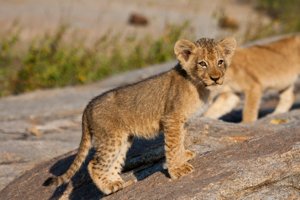
A curious lion cub
A curious lion cub, or "lionet".


8) LION CUBS HAVE TWO OTHER NAMES

Though they are usually referred to as "cubs", lion babies have two other names: "whelps" and "lionets".


9) LIONS ARE THE SECOND LARGEST CAT ON EARTH

After tigers, lions are the largest wild cats on the planet. Male lions can grow up to 10 feet in length and weigh up to 550 pounds, while female lions can grow to a length of 9 feet and weigh up to 395 pounds.


10) LIONS ARE UNDER THREAT

Only 34,000 wild lions remain in Africa, which is half of what it was only 30 years ago. Some scientists predict that wild lions could face extinction by the year 2050 if trends continue and humans don't increase their efforts to protect these amazing and powerful animals. The main threats to lions are loss of territory, lion/human conflict, and trophy hunting. As a traveler, you can do your part by traveling to national parks and game reserves that put resources toward protecting Africa's lions. By booking with Lion World Travel, you can be sure that you are helping to support lion conservation in Africa. 

Monday

Discoveries: River Cruise

Image credit: Luftner Cruises

River cruising offers an unparalleled level of convenience where you will enjoy smooth and peaceful sailing throughout your cruise. Once on board, you will only unpack once in your comfortable, fully equipped cabin.

River cruising is comfortable and convenient. There are no all-night parties, casinos on board (though some towns you visit may have them) or midnight buffets. You won't wait in long lines to dine and you don't need to get a number just to get off the ship. You will never have to tender into port as you stop right in the heart town.
River cruising in Europe is about experiencingand learning about the history and cities that are along the river. When you are cruising during the daytime it is often through the most historical and scenic spots in the area. Land is always in view so you're never just looking at water. Your boat is unique in that the restaurant is located on the mid-deck, which offers you floor to ceiling windows for great viewing while dining.
You won't deal with sea-sickness. Plus, there are no inside cabins or port holes, as all cabins have a window or a French Balcony. And if that's not enough...
Nine Reasons to Take a River Cruise over an Ocean Cruise 
  1. Fewer people: Ocean cruise lines can have 3,000 to 5,000 people on board. Your river cruise will have at most 150 passengers. You'll never wait in long lines to get on or off the ship. 
  2. Never get sea sick: You won't experience rough water or motion sickness -- only smooth and peaceful river sailing throughout your cruise. 
  3. Local destinations: Ocean cruises are restricted to cities near major bodies of water, while river cruising allows you to explore Europe's history rich cities and villages that are inaccessible except by river. 
  4. Dock right in town: River cruises allow docking right in the heart of a port town. Ocean cruise lines often stop way outside of the town you are visiting -- as far as 70 miles away. A river cruise not only saves you time, it allows you to easily maximize your time when in port without the expense and hassle of a taxi. 
  5. Convenience & scenic: Besides never having to take your turn to get off the ship, you won't tender into port and you'll never spend days watching nothing but the ocean go by. Rather, you'll be cruising by ancient villages, castles, and other historical and scenic sites. 
  6. Overnight in port: You overnight both in Budapest (pictured below) and Vienna, and have ample time to visit other charming ports, including Linz and Bratislava. This almost never occurs on an ocean cruise. 
  7. Inclusive pricing: Ocean cruises charge extra for everything including high charges for excursions and wine. On this river cruise, Country Travel DISCOVERIES has added included a variety of land excursions, outside cabins, all gratuities, and wine with dinner each evening. While a river cruise might cost you more up front, when you add all the extras on ocean cruises like shore excursions, gratuities, and outside cabins the price is a tremendous value. 
  8. Educational & local: Ocean cruises offer gambling, dancing, karaoke and Vegas-style shows. River cruises are more elegant and educational. The cuisine is local and is brought in from the surrounding area (not shipped in from faraway places with the lowest price). The quality wines (included at dinner) are from Europe's great wine regions.
  9. Better service: Fewer people mean more attentive service and a more personal relationship with the English-speaking staff.

Discoveries: Traveling On High Elevations

Few things are more exhilarating than taking in the eagle’s-eye view of the world offered by some of our mountain rail destinations. Whether we're chugging up a logging line 4,482 feet to West Virginia’s Bald Knob, or braving the optional Cog Railway's 8,000-foot ascent to the top of majestic Pikes Peak, surveying nature's wonders from such mountain perches are experiences that last a lifetime.
Yes, traveling at high elevations can thrill, but it can also affect the body and require time for adjustment. According to Medical Expeditions, a UK-based “medical adventure” group that researches the effects of high elevations on health, altitude starts to have an effect around 1,500 meters or 4,900 feet. The body starts to behave slightly differently in attempting to make up for the change in oxygen levels, as each breath starts to provide less oxygen until the body has time to adapt to the new conditions. Given enough time to adapt, most people can adjust to much higher altitudes – up to about 5,000 m or 16,400 feet (Everest base camp).
Here are some tips to help prepare for a safe and satisfying excursion to the heights:
Stay hydrated! Being sure to drink plenty of water is one of the best ways to help your body adjust to very high elevations, where low humidity, winds, and sun exposure can keep the air very dry.
Eat high-potassium foods, such as bananas, avocados, broccoli, or granola mix with dates or other dried fruit to help balance salt intake and maintain good electrolyte levels.
Pace yourselfRemember that many activities you may be accustomed to nearer sea level – from vigorous physical exercise to drinking spirits – can be intensified at high mountain attitudes. While you may find it easy to walk or bicycle 10 miles a day at sea level, six miles may be a challenge at first high in the Rockies. The effects of alcohol can be similarly amplified, so take it a little easy during those mountaintop happy hours!
Plan for shifting climates. In the dry air above Colorado, the effects of the direct sun can be felt powerfully for most of the year, even in winter, and skin protection, lip balms, sunglasses, and other precautions against both sun and chill are highly recommended. Dressing in layers will allow you to adjust to changing microclimates and windy conditions as you ascend and descend steep elevations or burrow through long underground tunnels.
Know how altitude may impact any medical conditionsTravelers who have pre-existing health issues – for example, asthma or high blood pressure – are advised to seek medical advice about plans for travel to high elevations and what complications might arise. Always bring spare medications, inhalers, steroids, etc. with you when setting out on a high-altitude excursion. Be sure to tell your Discoveries Director, guide or traveling companions immediately and honestly if you find yourself feeling ill.